Loading image...


Walk through any luxury lobby in 2026 and notice what happens when the focal wall is inert. Guests glance, look past, and keep moving. The dwell time you booked the architect to design for never arrives, the bar back behind reception does the heavy lifting, and the property loses the slow opening minutes that shape every review that follows. Hospitality designers have spent the last decade rebuilding that moment around fire, and the technology that made it possible at scale is the ventless built-in.
Biophilic and sensory design have moved from boutique experiment to baseline brief, and the flue-constrained gas insert that anchored an earlier generation of hotel fitouts is now the wrong tool for high-rise builds, retrofit lobbies, rooftop terraces, and any project whose timeline cannot absorb a chimney coordination meeting. The default specification in luxury hospitality has changed.
The problem most operators run into is that almost everything written about built-in fireplaces addresses homeowners. This guide is the opposite. It is built for hotel developers, F&B operators, hospitality designers and procurement specifiers who need real product data, regional compliance detail, multi-fireplace venue planning, and operations guidance for built-in fireplaces for hospitality across hotels, restaurants and resorts.
Loading image...
A built-in fireplace recesses into the architecture rather than sitting in front of it. Where a freestanding unit is a piece of furniture and an insert retrofits an existing masonry opening, a built-in is integrated at the fabric stage, framed into joinery, marble feature walls, double-sided room dividers, lobby focal columns or bar-back illumination. For a commercial fitout that distinction matters because the appliance becomes part of the design language, not a fixture sitting on top of it.
For hospitality work, that integration unlocks three patterns competitors rarely talk about. The first is design continuity across a venue, where the same product family runs from lobby to bar back to suite without the visual jolt of different fire technologies. The second is the double-sided configuration that splits a single firebox between two rooms, often used to divide a lobby from a lounge without losing either side's atmosphere. The third is the recessed feature column that anchors a check-in or host-stand axis and provides a slow-moving visual cue while staff process arrivals.
EcoSmart Fire ships three commercial-grade built-in technologies into hospitality projects: bioethanol (the Flex, Frame, Heritage and XL burner ranges), electric flame-only (Switch FX), and electric with heat (Motion). Each has a place in the venue plan, and the table below is a starting point before the deeper technology comparison further down.
Technology | Range | What it delivers |
|---|---|---|
Bioethanol | Flex, Frame, Heritage, XL burners | Real flame, no flue, indoor or outdoor under cover |
Electric flame-only | Switch FX | Simulated flame, silent, indoor only, unattended overnight operation |
Electric with heat | Motion | Simulated flame plus radiant heat, indoor only |
The deeper decision logic comes a few sections down. The point here is that the commercial specifier is choosing between three valid technologies inside a single brand family, which keeps procurement clean and visual identity coherent across a multi-fireplace venue.
Hospitality is not one space. Lobbies, suites, restaurants, bars and resort terraces each ask different things of a fire feature, and the matching specification looks different in each. Scale, dwell time, fuel type, operating hours and indoor-outdoor exposure all shift the answer. The breakdown below walks the three core venue types in order and matches each to the built-in fireplaces collection that suits the brief.
Venue type | Typical zones | Recommended ESF range | Indicative viewing width | Indicative heat output |
|---|---|---|---|---|
Hotel | Lobby, suite, lounge, spa | Flex, Frame, Heritage, Motion | 600 mm to 4,030 mm | 5,800 to 48,600 BTU/h (1.7 to 14.2 kW) |
Restaurant or bar | Dining wall, bar back, private dining | Flex, XL burners, Frame, Switch FX | 596 mm to 1,200 mm | 6,000 to 30,000 BTU/h (1.8 to 8.8 kW) |
Resort | Outdoor terrace, rooftop bar, alfresco dining, poolside | Flex, Heritage (under cover) | 1,150 mm to 4,030 mm | 16,200 to 48,600 BTU/h (4.7 to 14.2 kW) |
Lobbies are about scale and statement, and the wider single-sided Flex units carry that weight. The Flex 158SS delivers a 4,030 mm viewing width at 45,870 BTU/h (13.4 kW), which is the kind of feature wall a high-rise lobby can be built around without a flue penetration through twenty floors of finished slab. The Flex 86SS through Flex 122SS handle smaller hotel lobbies, and the Heritage 56SS suits boutique heritage properties where a traditional grate-and-log aesthetic reads truer than a linear ribbon.
Suites change the brief entirely. At-room intimacy and noise discipline matter more than statement scale, and the Frame range with its toughened low-iron glass front sits comfortably inside a guest room. Heritage 26SS is the right size for boutique suites where the firebox needs to feel built into the wall rather than imposed on it. Where a hotel suite operates under prohibitions on open flame, or where overnight unattended operation is part of the in-room ritual, the silent Motion electric range delivers the visual without the staff overhead.
Lounges and bar lounges are where the double-sided format earns its keep. A see-through unit like the Flex 86DB lets a single firebox divide bar from lounge without losing either side's atmosphere, and the 30,000 BTU/h (8.8 kW) output supports both volumes simultaneously. Spa and wellness rooms benefit from the Heritage range's softer aesthetic, and the closed-combustion bioethanol burn keeps treatment-room air quality intact, which is not something a wood or gas alternative can promise.
High-rise compliance sits underneath all of this. The Flex and Heritage ranges are explicitly approved for high-rise buildings, which rules out the single biggest compliance objection that derails flued gas in metropolitan hotel projects.
Loading image...
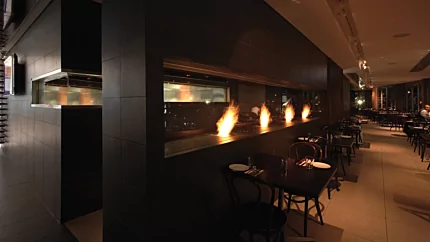
Dining-room focal walls are dominated by linear formats. The Flex 86SS and Flex 122SS sit naturally inside bespoke millwork or stone surrounds, and the burn time of 7 to 14 hours per fill covers a full service-and-evening shift without staff intervention mid-service. For bar backs the geometry shifts toward shallower viewing depth and a strong horizontal line, which is where the XL700, XL900 and XL1200 linear burners come in. They recess into back-bar architecture with marble, stone or timber surrounds and let the bottles read against a low ribbon of real flame.
Private dining rooms and chef's tables want a single focal point at small scale. The Frame 600 fits above the table line without overheating an intimate room, and the BK5 square burner offers a contained 11.4-inch flame for low-profile applications. Food-service air quality is the operational reason restaurants choose bioethanol over wood, charcoal or open gas: closed-combustion bioethanol produces no smoke, soot or ash, which preserves the air standard the kitchen brigade and the cellaring program both depend on. Fabric banquettes, printed menus and stored wine all sit closer to a built-in fireplace than they would to any other heat source, and competitors gloss this point.
A separate operational note for kitchen-adjacent zones and certain mall fit-outs, where open flame is restricted by local code or by landlord conditions. The Switch FX and Motion electric ranges deliver the same visual without the flame, which keeps the design intent intact when the regulatory environment will not allow combustion.
Outdoor hospitality is where the competitor field thins out almost completely. Every editorial round-up either ignores resort terraces or treats them as a footnote, which is a strange omission given how much of the luxury resort experience now happens outside the building. The Flex and Heritage ranges are indoor-outdoor rated, and that single fact is what makes them the right tool for rooftop bars, alfresco dining decks, pool terraces and resort lodges.
One outdoor specification rule matters more than any other: the unit must sit under a protective overhang. A pergola, a roof, an awning, or a covered terrace counts; direct exposure to weather voids the warranty. The detailed pergola and patio install mechanics live in the dedicated indoor-outdoor built-in fireplaces treatment, so this article keeps the focus on hospitality specification rather than repeating that ground.
Scale-wise, the Flex 122SS or Flex 158SS handle large open terraces without a flue penetration through a finished roof, which is the install reality that knocks out flued gas in retrofit rooftop projects. For resort lodges and country-house hotels the Heritage range's traditional grate-and-log aesthetic suits the brief better than a linear ribbon, and the Heritage 42SS or 56SS slots into lodge sitting rooms or wellness pavilions without fighting the architecture. EcoSmart Fire's hospitality portfolio across this category includes The Brindabella restaurant, FUFU KYU-KARUIZAWA resort, and The Lake View Toya Nonokaze Resort in Japan, which is the kind of proof point editorial competitors cannot match.
Specify bioethanol when guests should see a real flame and the venue can support a staff-led refuelling routine. Specify electric when local code prohibits open flame, when the fireplace must operate unattended overnight, or when the only viable location is fully enclosed indoors with no path to mechanical ventilation. That is the short answer; the longer one walks through six decision factors that matter at hospitality scale.
The first factor is the flame itself. Real flame from a bioethanol unit reads as a hearth in every research instrument we know about. Christopher Lynn's 2014 study, published in Evolutionary Psychology, found that watching a hearth fire produces significant blood-pressure reductions across a sample of 226 participants, with the effect strongest when natural sound is present. Simulated flames perform measurably worse on the same instruments. If the project brief asks guests to slow down and dwell, real flame is doing work that electric cannot fully replicate.
The second factor is fuel logistics. Bioethanol requires a staff refuelling routine, fire-rated fuel storage, and a sensible day-to-day operational rhythm. Electric needs a dedicated 20-amp two-pole circuit and nothing else. The third factor is operating hours and unattended operation, where electric wins outright; the Switch FX and Motion can run overnight in a lobby without a staff member nearby. The fourth is noise: Motion includes a wood-crackling soundscape that reads correctly in a lobby but would intrude on a fine-dining table. The fifth is indoor versus outdoor, where electric is indoor only, full stop. The sixth is running cost, where Motion runs at roughly two cents per hour in flame-only mode and roughly twenty-four cents per hour with heat at 1,500 W; bioethanol running cost depends on burner size and fill frequency.
Factor | Bioethanol (Flex, Frame, Heritage) | Electric flame-only (Switch FX) | Electric with heat (Motion) |
|---|---|---|---|
Flame | Real | Simulated | Simulated |
Heat output | Yes, supplemental | None | 1,500 W on demand |
Indoor or outdoor | Indoor and outdoor under cover | Indoor only | Indoor only |
Unattended operation | Not designed for it | Yes | Yes |
Fuel logistics | Staff refuelling, fire-rated storage | None | None |
Open-flame code restriction | May rule out | Always permitted | Always permitted |
For the deeper bioethanol-versus-traditional comparison there is a dedicated bioethanol built-in fireplaces article inside the cluster. The decision rule of thumb for hospitality is simple: default to bioethanol where the venue can support it, fall back to Switch FX or Motion where code, location or operating hours make real flame impractical.
EcoSmart Fire's built-in bioethanol fireplaces hold third-party certification to UL 1370 in North America, EN 16647 / BSI in the UK and EU, and comply with ACCC mandatory standards in Australia, which makes them eligible for specification in commercial and public-access venues across all three regions. That sentence is the answer to the single most common procurement question a hospitality specifier asks about ventless fireplaces.
UL 1370 is the North American safety certification that EcoSmart Fire helped develop, and the brand holds the largest certified ethanol portfolio in the region with more than 100 lab tests behind it. EN 16647 is the European safety certification, issued by BSI. ACCC is the Australian framing that procurement teams sometimes get wrong: it is not a certification mark the product carries, it is a mandatory standard the product complies with, and the correct framing in any tender response is "complies with ACCC standards", never "ACCC-certified".
Region | Standard | Type |
|---|---|---|
North America | UL 1370 | Safety certification |
UK and EU | EN 16647 / BSI | Safety certification |
Australia | ACCC | Mandatory compliance |
High-rise approval is the second compliance point worth stating clearly. The Flex and Heritage ranges are explicitly approved for high-rise buildings, which is the single most decisive compliance fact in metropolitan hotel and restaurant fit-outs. Zero-clearance engineering, closed combustion, no smoke or soot or ash, and no flue penetration are the engineering reasons that approval is possible.
For public-access deployment the appliance is supplemental and decorative, never a primary heat source, and the BTU/h figures should not appear in HVAC heat-load calculations. Operational safety covers staff refuelling routine (treated in the operations section below), minimum clearances per the model-specific diagram, and mantle and surround clearances against combustible versus non-combustible materials. The honest limitation: third-party certification gives the appliance eligibility, but the install must still satisfy local fire safety, ventilation and BCA, NCC or Building Regulations review on a project-by-project basis. No certification removes that step.
Built-in bioethanol fireplaces require approximately 5.7 m³ (200 ft³) of room air space per 1,000 BTU/h of heat output. For a Flex 86 at 30,000 BTU/h (8.8 kW), that means a minimum room volume of around 220 m³. The formula is straightforward and the indicative minimums across the hospitality-relevant ranges drop out of it directly.
Model | Heat output | Minimum room volume |
|---|---|---|
Flex 18 | 5,800 BTU/h (1.7 kW) | 40 m³ |
Flex 86 / 68 | 16,200 BTU/h (4.7 kW) | 115 m³ |
Flex 104 / 122 | 30,000 BTU/h (8.8 kW) | 220 m³ |
Flex 158 | 48,600 BTU/h (14.2 kW) | 345 m³ |
Frame 1500 | 15,290 BTU/h (4.5 kW) | 115 m³ |
The multi-fireplace caveat matters in hospitality more than in any other context. The formula applies per appliance, but where two or more fireboxes share a room volume, the ventilation budget must support the combined BTU/h load. A lobby that anchors a Flex 122SS as its centrepiece and adds a Flex 86DB as a lounge divider is drawing on a single air volume for both, and the room calculation has to reflect that.
Mechanical ventilation is the practical mitigator. Most hospitality interiors run mechanical HVAC at occupancy-driven rates that comfortably exceed the air-infiltration requirement, so the room-volume figure operates as a sanity check rather than a hard constraint in most fitouts. The recurring honest reminder: this is decorative supplemental warmth, never a primary heat source, and HVAC sizing should not assume any contribution from the fire feature.
Installation is where the commercial value of the technology becomes visible on the programme schedule. A bioethanol built-in installs with no gas line, no flue penetration, no chimney, no electrical works for the bioethanol ranges, no structural modification to the building shell, and a single tradesperson. On a hotel refurbishment that compresses one of the longest historical critical-path items into something that slots into the joinery package rather than the mechanical and electrical package.
Practical fitout considerations cluster around four points. Recessed framing must be self-supporting above the appliance, since the unit itself is not load-bearing. Surround materials need to respect the minimum clearance diagram supplied with each model, and combustible versus non-combustible distinctions matter for the immediate envelope. Outdoor installations under pergolas or overhangs need to clear the protective-cover requirement before specification, and the Motion electric range requires a dedicated 20-amp two-pole circuit run to its location. A useful aside for project managers: because the fireplace install lives inside the joinery scope, it tends to coordinate with the timber and stone subcontractors rather than with the M&E team, which changes who owns the snagging.
For projects that need a fuller pre-installation walkthrough, the cluster carries a dedicated ventless built-in fireplaces checklist that maps the residential equivalent of these checks. The commercial fitout follows the same logic at a larger scale, with the joinery package as the natural home for the install.
Day-to-day operation is where hospitality fitout differs from residential most visibly. The fuel is e-NRG bioethanol, a carbon-neutral closed-combustion fuel that produces no smoke, no soot and no ash, and that ships in the hospitality-relevant regions as pack sizes suited to the local market. Burn time per fill runs between 7 and 14 hours depending on burner configuration, which covers a full service-and-evening cycle without a mid-service refuel.
Refuelling protocol at a high level looks like this:
Allow the appliance to cool completely before opening.
Decant from a manufacturer-approved jerry can; never decant near an open flame.
Keep the room ventilated during the refuel.
Wear gloves where the model-specific diagram indicates.
Wipe spills before re-ignition.
Fuel storage is the second operational consideration. Bioethanol stores in a designated fire-rated storage cabinet, located away from heat sources and in line with local hazardous-goods storage rules. Most hotels assign the cabinet to a back-of-house store adjacent to the housekeeping office or the engineering store; restaurants typically locate it inside the cellar pathway. Either approach is correct, provided the cabinet specification meets local code.
Regional fuel supply is the one logistical asterisk worth flagging early in any project brief. e-NRG bioethanol is supplied directly in the USA, Canada, Australia and the UK, but it is not distributed inside the EU. EU venues continue to source bioethanol locally from non-e-NRG suppliers, which works perfectly well for the appliance but should be confirmed at procurement stage so the fuel relationship is built in before the venue opens.
For electric ranges the operational footprint collapses to nothing. There is no fuel, no refuelling, no storage cabinet and no jerry can routine. Motion runs at roughly two cents per hour in flame-only mode and roughly twenty-four cents per hour when the 1,500 W heat element is engaged, which makes it the easiest line on any operations budget.
Luxury hospitality venues rarely deploy a single fireplace. A typical five-star property places one in the lobby, one in the bar back, one in the restaurant's feature wall and one on the resort wing's outdoor terrace. That is four distinct moments in the guest journey, each with its own dwell time, its own audience and its own operational rhythm. Coordinating them is the part competitors do not write about, and it is where the cluster's hospitality fireplace collection shows its value.
The first planning move is to choose one product family for visual coherence and vary the scale by zone. A property that runs Flex across all four zones reads as a single design language; a property that mixes Flex with two unrelated brands reads as four different decisions. Operational rhythm benefits from the same discipline: staff refuel one zone per day on a rotating schedule rather than refuelling four units on the same afternoon, which spreads the operational footprint across the week and keeps fuel handling out of peak guest-service hours.
A worked example helps. Imagine a notional five-star city hotel with a Flex 122SS in the lobby, a Flex 86SS in the restaurant feature wall, an XL900 set into the bar back, and a Flex 158SS under a covered terrace in the resort wing. The combined bioethanol output is roughly 130,000 BTU/h (38 kW) across four appliances, and because no two units share a room volume the ventilation calculation runs per appliance rather than aggregated. Refuelling rotates Monday to Thursday across the four zones, which keeps the fuel cabinet turnover predictable and means no single member of staff is responsible for refuelling more than one fire in a day. That is what a multi-fireplace venue looks like when the operational logic is designed at the same time as the visual.
Hospitality procurement teams are not interested in marketing language about sustainability. They are interested in evidence that survives an ESG audit or a LEED, BREEAM, Green Star or NABERS submission. The built-in bioethanol and electric stack performs well against those criteria when the claims are framed honestly.
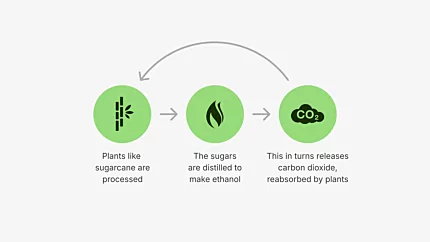
e-NRG bioethanol is fermented from sugarcane and corn, both renewable feedstocks, and burns to carbon dioxide and water vapour with no particulate output.
There is no flue, so none of the generated heat is lost up a chimney; 100% of the heat produced stays in the room.
The electric ranges produce zero on-site emissions and shift the carbon question to the grid mix, which most major hospitality groups already account for in their reporting framework.
Closed combustion eliminates smoke, soot, ash and the indoor-air-quality penalty associated with traditional hearths.
The honest limitation in any procurement response: bioethanol combustion does still produce carbon dioxide at the point of use, in the same way every combustion process does. The renewable-feedstock cycle is what underwrites the carbon-neutral framing, and any project documentation should treat that as a lifecycle claim rather than a point-of-use claim. Procurement teams that test the language tend to credit the honesty.
Loading image...
Before issuing a tender for built-in fireplaces across a hospitality project, work through this list. The answers shape the specification, the procurement timeline and the operational design.
Which guest zone is the fireplace serving, and what is the target dwell time in that zone?
Indoor, outdoor under cover, or fully exposed to weather?
Is real flame permitted by local code and landlord conditions?
Single-sided, double-sided, corner or bay configuration?
Required viewing width and the minimum room volume available?
Operating hours, and does the unit need to run unattended overnight?
Staff refuelling capacity and a viable fuel-storage location available?
Surround material and load above the appliance?
Regional compliance: UL 1370, EN 16647 or ACCC required?
Are multiple fireplaces in scope across the venue, and how do they coordinate?
The cluster's commercial built-in fireplaces reference is the next sensible stop, alongside a direct conversation with the EcoSmart Fire commercial team to walk a project brief through specification and supply.
Built-in fireplaces have moved from optional design flourish to default specification for luxury hospitality. The technology that made the shift possible is ventless, the operational logic is well understood at venue scale, and the regional compliance picture is settled across the three regions where most luxury hotel groups operate. What remains is the design decision: which zones, which technologies, which scale and which rhythm.
The opening minutes of every guest stay still happen at the focal wall behind reception. That moment now has a tool built to anchor it, and the rest of the venue follows the same logic. From lobby to bar back to suite to terrace, the built-in fireplace has become a hospitality design signature, and the specification work behind it is what separates a venue that opens well from one that quietly underperforms.